Navigate to Integrations in the left sidebar.
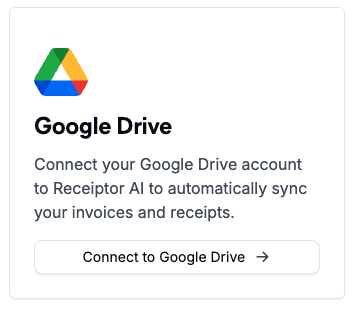
Find the Google Drive card and click Connect.
Authenticate with your Google account and grant the requested permissions.
Receiptor AI creates a Receiptor_AI folder in your Google Drive where all exports are stored.
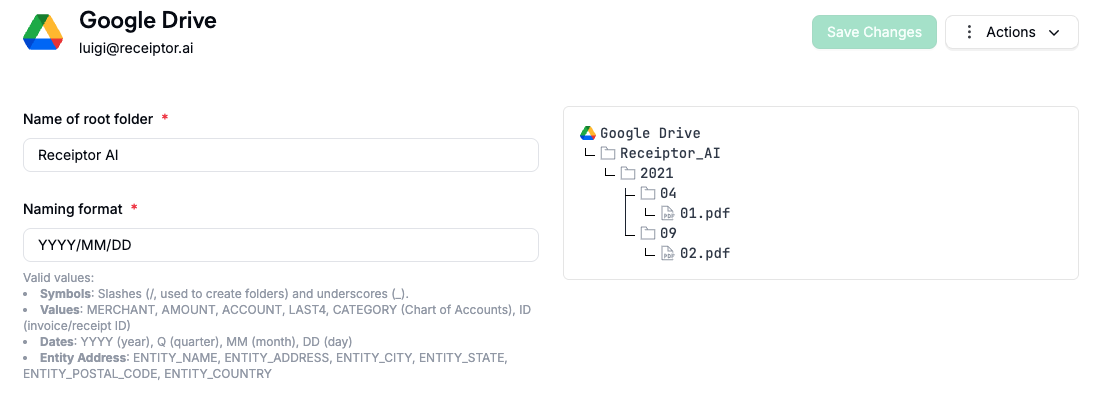
After connecting, define how documents are organized by clicking Settings on the Google Drive integration. Use / to create folder levels and _ to separate filename parts.
Available tokens:
Document |
|
Date |
|
Entity address |
|
Example: YYYY/MM/MERCHANT_ID creates year and month folders with files named by merchant and document ID.
In the Documents section, select the documents you want to export.
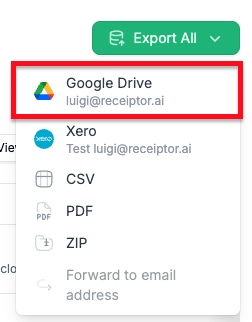
Click Export All.
Choose Integration, then select Google Drive.
Click Export.
Use an Automation Rule to send documents to Google Drive as they are processed. Set the action to Store In and select your Google Drive connection.

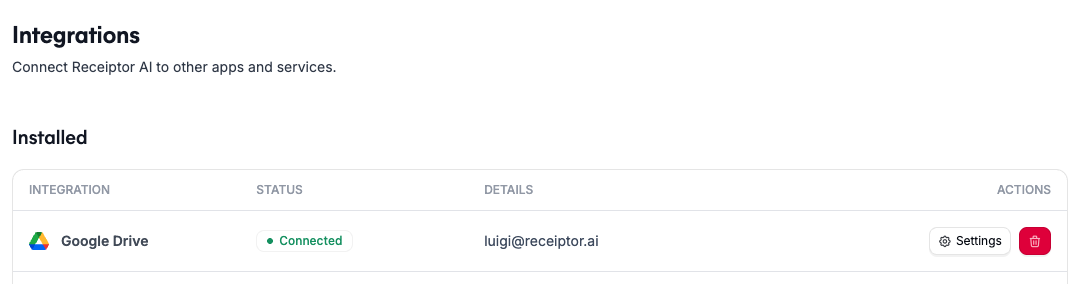
Go to Integrations, find the Google Drive card, and click the three-dot button to access settings or remove the connection. Disconnecting does not delete any files already exported to your Drive.
Q: Where are files stored in my Google Drive?
A: Files are stored in a Receiptor_AI folder at the root of your Google Drive. Your folder structure tokens determine the subfolder organisation inside that folder.
Q: Can I connect multiple Google Drive accounts?
A: Yes.
Q: Will Receiptor AI access anything else in my Google Drive?
A: No. Receiptor AI only writes to the Receiptor_AI folder it creates. It does not read or modify any other files in your Drive.
Q: Can I change the folder structure after documents have already been exported?
A: Yes. Changes affect future exports only. Previously exported files remain in their original locations.
Still have questions? Reach out via the in-app chat or at [email protected].